
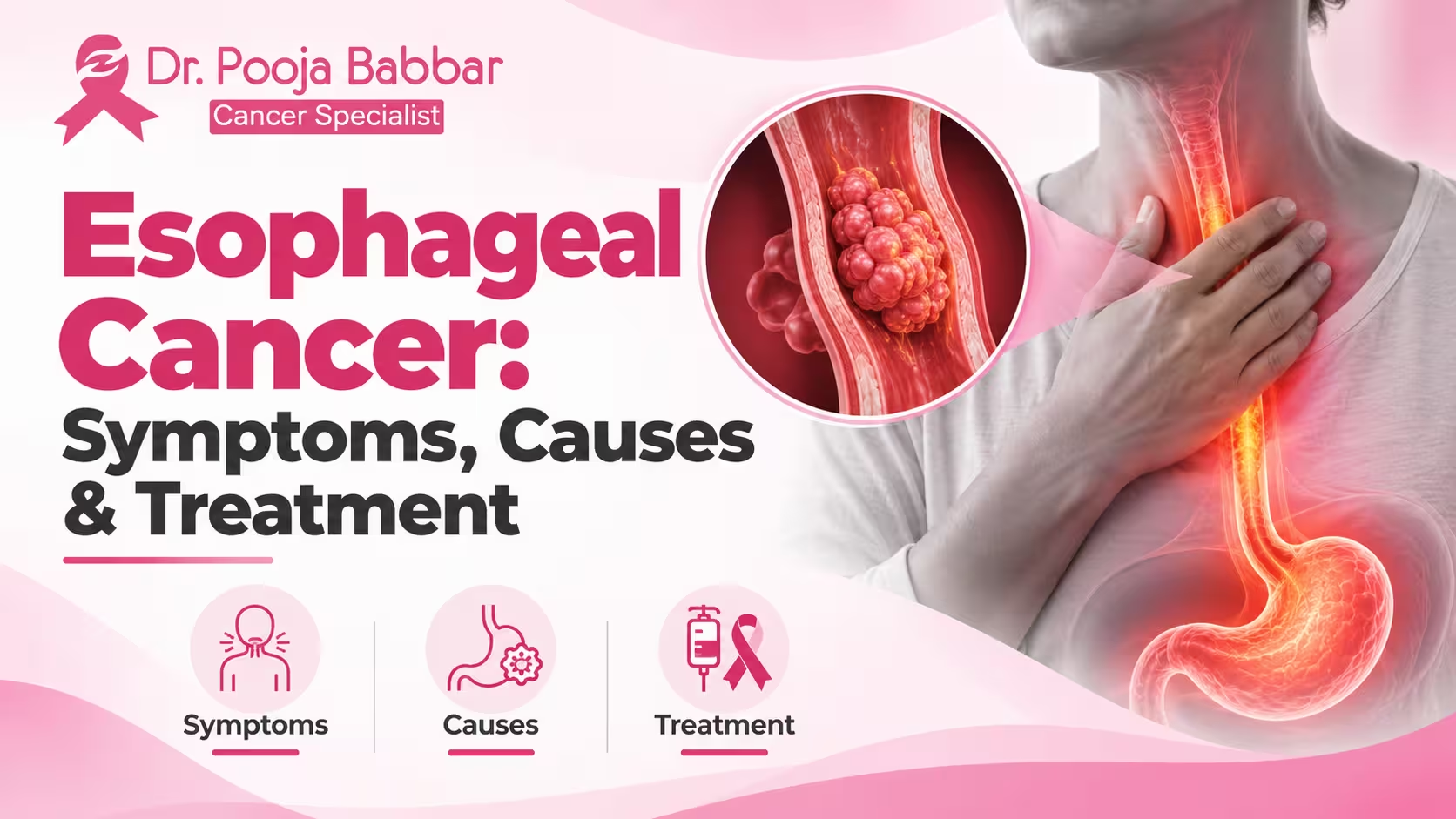
Esophageal cancer is a malignant tumor of the food pipe connecting the throat to the stomach, primarily presenting as difficulty swallowing (dysphagia), unexplained weight loss, and chest pain. Treatment options include surgery (esophagectomy), chemotherapy, radiation therapy, immunotherapy, and targeted treatments.
What Is Esophageal Cancer?
Esophageal cancer develops when abnormal cells grow uncontrollably in the esophagus, the muscular tube that connects the throat to the stomach. As the tumour grows, it may interfere with swallowing and can spread to nearby tissues or other parts of the body.
The two main types of esophageal cancer are:
- Adenocarcinoma: Often develops in the lower part of the esophagus and is associated with conditions such as chronic acid reflux and Barrett’s esophagus.
- Squamous cell carcinoma: Develops in the flat cells lining the esophagus and commonly affects the upper or middle portions.
The type, location, and stage of the cancer help doctors determine the most appropriate treatment plan.
Esophageal Cancer Symptoms
Esophageal cancer may not cause noticeable symptoms in its early stages. As the tumour grows, it can narrow the esophagus and make swallowing increasingly difficult.
Common esophageal cancer symptoms include:
- Difficulty swallowing (dysphagia): Food may feel stuck in the throat or chest, initially with solid foods and later sometimes with liquids.
- Unexplained weight loss: Difficulty eating may lead to reduced food intake and weight loss.
- Persistent heartburn: New or worsening heartburn or indigestion may require medical evaluation.
- Chest pain: Discomfort or pain behind the breastbone may occur.
- Persistent cough or hoarseness: These symptoms can develop when the cancer affects nearby structures.
- Painful swallowing: Eating or drinking may become uncomfortable.
- Bleeding: Some people may vomit blood or pass black, tarry stools.
These symptoms can also occur with non-cancerous conditions. However, persistent difficulty swallowing, unexplained weight loss, or bleeding should be assessed promptly by a healthcare professional.
What Causes Esophageal Cancer?
The exact cause of esophageal cancer is not always known. It develops when changes in cells cause them to grow abnormally. Certain lifestyle habits and medical conditions can increase the risk.
Important risk factors include:
- Tobacco use: Smoking and other tobacco products increase the risk of esophageal cancer.
- Heavy alcohol consumption: Regular, heavy alcohol use is associated with a higher risk, particularly of squamous cell carcinoma.
- Chronic acid reflux: Long-term gastroesophageal reflux disease (GERD) can damage the lining of the esophagus.
- Barrett's esophagus: This condition involves changes in the esophageal lining and increases the risk of adenocarcinoma.
- Overweight or obesity: Excess body weight is associated with a higher risk of esophageal adenocarcinoma.
- Older age: The risk generally increases with age.
Having one or more risk factors does not mean a person will definitely develop cancer. Similarly, esophageal cancer can occur in people without obvious risk factors.
How Long Can You Have Esophageal Cancer and Not Know?
Esophageal cancer can develop without noticeable symptoms for months or potentially longer. There is no fixed timeline because the rate of growth varies according to the cancer type and other individual factors.
The esophagus can stretch to accommodate food, so early changes may not immediately interfere with swallowing. Symptoms often become more noticeable when a tumour begins narrowing the passage.
Persistent or worsening difficulty swallowing is an important warning sign and should not be ignored. People with chronic acid reflux or Barrett's esophagus should discuss their individual risk and appropriate monitoring with their doctor. Early assessment can help identify the problem and determine the next steps.
How Is Esophageal Cancer Diagnosed?
Some of the tests used in the diagnosis of esophageal cancer include the following.
- Upper endoscopy: This is done using a thin, flexible tube with a camera that is passed through the mouth to the esophagus.
- Biopsy: This is the collection of a small tissue sample that is done during endoscopy and subsequently examined for the presence of cancer. Often a biopsy is needed for diagnosis.
- PET-CT or CT scans: These scans are done to evaluate the tumor and to find if cancer has spread to other locations of the body.
- Endoscopic ultrasound: This test is done to see the depth of the tumor within the wall of the esophagus and nearby lymph nodes.
These tests are not done for all patients. Often they are done based on the stage of cancer and the treatment being provided.
Esophageal Cancer Treatment Options
Esophageal cancer treatment depends on the cancer type, stage, tumour location, and the patient's overall health. A multidisciplinary team may recommend one treatment or a combination of approaches.
1. Surgery
Surgery may be an option for early-stage or operable cancer. Depending on the situation, the surgeon may remove the affected portion of the esophagus and nearby tissues. Very early cancers may sometimes be removed through endoscopic procedures.
2. Chemotherapy and Radiation Therapy
Chemotherapy uses medicines to destroy cancer cells or slow their growth. Radiation therapy uses high-energy radiation to damage cancer cells. These treatments may be given before surgery, after surgery, or together when surgery is not suitable.
3. Targeted Therapy and Immunotherapy
Targeted therapy acts on specific features of cancer cells, while immunotherapy helps the immune system recognize and attack cancer. These options may be appropriate for certain tumour types or advanced disease, depending on test results.
Treatment is individualized, and the oncology team will explain the potential benefits, side effects, and goals of each option.
Is Esophageal Cancer Curable?
Yes, esophageal cancer can be curable in some cases, particularly when it is detected early and can be completely removed or treated. Some very early cancers may be managed with endoscopic procedures, while other cases may require surgery combined with chemotherapy or radiation therapy.
When cancer has spread to distant organs, treatment generally focuses on controlling the disease, relieving symptoms, and improving quality of life. In selected cases, systemic treatments can help people live longer.
The possibility of a cure depends on the cancer stage, tumour characteristics, overall health, and response to treatment. An oncologist can explain the realistic treatment goals for an individual patient.
Esophageal Cancer Survival Rate
The esophageal cancer survival rate describes how people with this cancer have fared over time. A commonly used measure is the five-year relative survival rate, which compares people diagnosed with cancer with similar people in the general population.
According to the US National Cancer Institute's SEER data for 2016–2022, the overall five-year relative survival rate for esophageal cancer was 22.2%. The rate was approximately 48.6% for localized disease, 29.1% for regional disease, and 5.3% for distant disease.
These figures are based on US population data and may not reflect outcomes in India. They are also estimates for groups of people, not predictions for an individual. Cancer type, stage, treatment advances, and response to therapy can all affect outcomes.
Conclusion
Esophageal cancer can be difficult to recognize in its early stages because symptoms may develop gradually. Persistent difficulty swallowing, unexplained weight loss, worsening heartburn, or chest discomfort should not be ignored. Although the disease can be serious, early diagnosis may expand treatment options and improve the chances of successful treatment. If you have concerning symptoms or need guidance following a diagnosis, consult Dr. Pooja Babbar, Medical Oncologist in Gurgaon, for an assessment and an individualized discussion of appropriate cancer treatment options.
Frequently Asked Questions
1. What is the first warning sign of esophageal cancer?
Difficulty swallowing is a common warning sign. Some people also experience persistent heartburn, chest discomfort, or unexplained weight loss.
2. Can esophageal cancer cause heartburn?
Yes, heartburn can occur with esophageal cancer. However, heartburn is much more commonly caused by acid reflux and does not automatically indicate cancer.
3. How is esophageal cancer confirmed?
Upper endoscopy allows doctors to examine the esophagus, and a biopsy of suspicious tissue is generally needed to confirm cancer.
4. Is esophageal cancer curable if detected early?
Early-stage esophageal cancer may be curable with appropriate treatment. The best approach depends on the tumour's location, type, and extent.
5. When should difficulty swallowing be evaluated?
Seek medical evaluation if swallowing becomes persistently difficult or progressively worse. Inability to swallow saliva, choking, or severe breathing difficulty requires urgent medical attention.


